
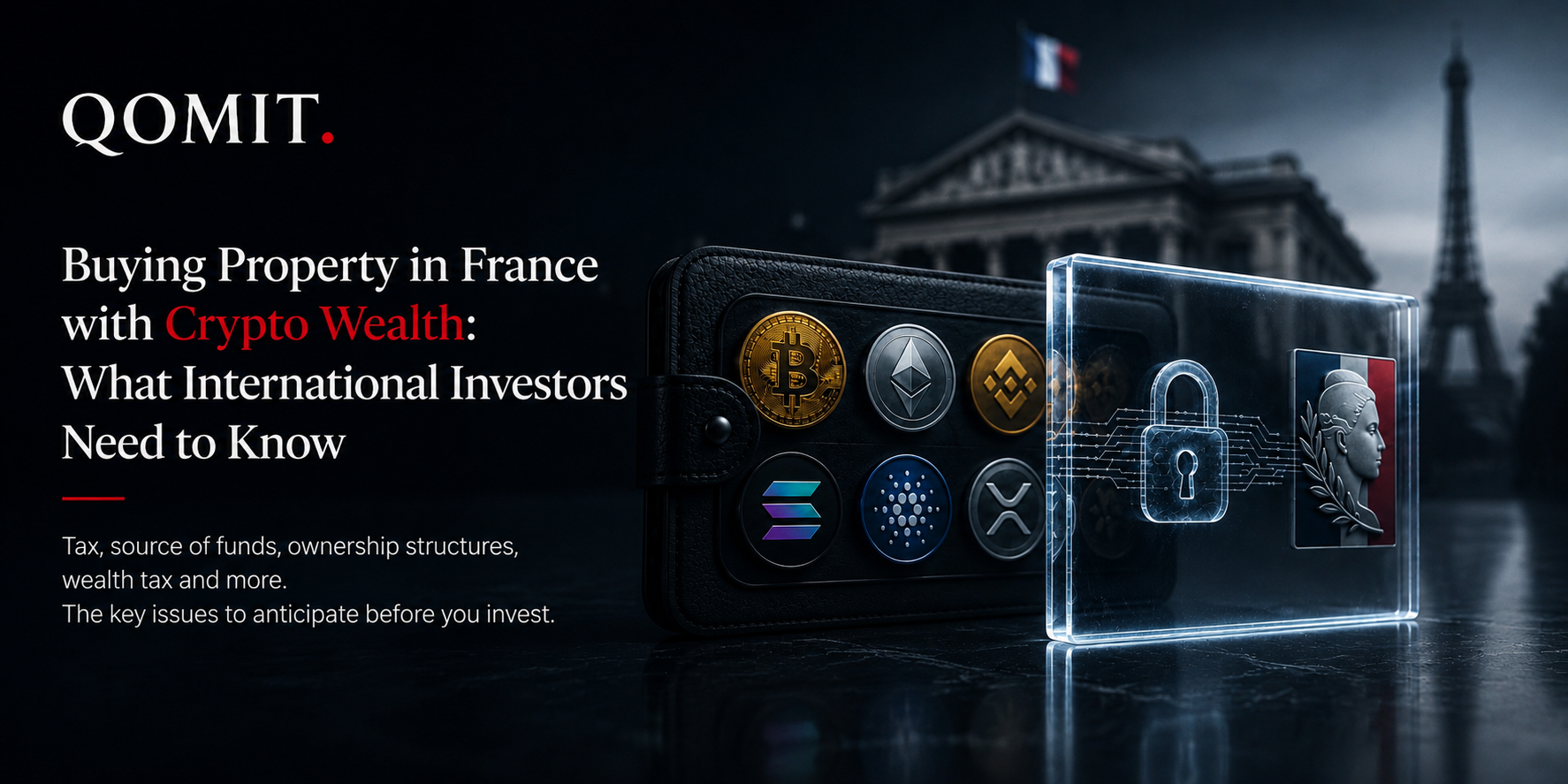
You live in Dubai, London, Geneva, Singapore or New York. You hold €2 million in crypto assets and want to buy a €1 million apartment in Paris or a property on the French Riviera.
You have the money. So what could possibly be complicated?
Potentially, quite a lot.
Owning sufficient crypto wealth and having funds that are ready to enter a French real estate transaction are two very different things.
Between an investor’s wallet and the completion of a French property acquisition lie several legal, tax and practical questions: where and when the crypto should be converted, how the source of funds will be documented, which ownership structure should be used, whether French wealth tax may apply and how the property will eventually be held, transferred or sold.
This is no longer a theoretical issue.
In January 2026, CoinDesk reported that European crypto payment provider Brighty said it had already facilitated more than 100 property transactions for wealthy crypto holders, including acquisitions in France, with transaction values ranging from approximately $500,000 to $2.5 million.
For investors whose digital assets have grown into significant private wealth, French real estate can represent an attractive way to diversify into tangible assets.
But the right question is no longer simply:
“Can I buy property in France with crypto?”
It is:
“How should I turn my crypto wealth into French real estate?”
This distinction matters.
An investor may convert part of a crypto portfolio into euros before the acquisition and transfer the resulting fiat funds into the conventional banking and notarial system.
In some circumstances, a transaction involving crypto assets more directly may also be contemplated, provided that the seller agrees and the legal and operational structure is workable.
A third possibility is to retain some or all of the crypto portfolio and finance the acquisition through debt, potentially using other assets — and, in some specialised arrangements, crypto assets — as collateral.
These routes do not produce the same legal, tax or financial consequences.
For most international investors, therefore, the payment mechanism is only one part of a much broader wealth-planning decision.
Before moving the assets, five issues deserve particular attention.
This should generally be the starting point.
The French tax regime applicable to a French tax resident disposing of crypto assets should not simply be transposed to an investor living in the UAE, the United Kingdom, Switzerland, the United States or another jurisdiction.
Before converting a substantial crypto portfolio to finance a French acquisition, the investor should establish, among other things:
This matters particularly where an investor has recently relocated internationally.
A €1 million conversion made shortly before a French property acquisition is not simply a banking operation if it crystallises several years of unrealised gains.
The tax analysis should therefore take place before the crypto is sold — not after the euros have arrived in France.
Timing can matter.
So can tax residence.
And so can the history of the portfolio.
This is one of the most important issues in property transactions involving significant crypto wealth.
Suppose an investor can demonstrate that a wallet under his or her control contains €2 million worth of bitcoin.
That answers one question:
Where are the assets today?
It does not necessarily answer another:
How was the €2 million of wealth originally created?
This distinction between source of funds and source of wealth is particularly important for long-standing crypto investors.
Someone who acquired bitcoin in 2016 using documented personal savings presents a very different profile from an investor whose current holdings result from years of trading across multiple exchanges, DeFi protocols, staking, bridges and self-custody wallets.
Depending on the history, a robust file may need to connect several layers of evidence:
fiat funds → initial crypto acquisitions → exchanges → personal wallets → subsequent transactions → current holdings → conversion → euros used for the French acquisition.
Bank statements, exchange records, wallet addresses, transaction histories, tax filings and blockchain analysis may therefore complement one another.
The key point is simple:
The blockchain can trace a transaction. It does not necessarily explain the economic and tax history of the wealth behind it.
For a substantial French property acquisition, that history may need to be made intelligible before the funds move.
French real estate transactions take place in a regulated environment.
French notaries are subject to anti-money laundering and counter-terrorist financing obligations and must exercise the required level of due diligence in relation to the transaction and the funds involved.
This does not mean that crypto-derived wealth is inherently problematic.
It means that a complex crypto history should not be presented to the professionals involved as an unexplained bank transfer arriving a few days before completion.
The same issue can arise earlier with the bank receiving the proceeds of the crypto conversion or with the regulated crypto service provider carrying out the transaction.
In the matters QOMIT handles, we therefore focus on preparing the French side of the transaction sufficiently early: understanding how the wealth was created, reviewing its tax history where relevant, identifying the conversion route and anticipating the documentation that may be needed.
Where the transaction history is particularly complex, specialist blockchain analysis can be used alongside the legal, tax and financial documentation.
The objective is not to hand a notary or bank thousands of pages of transaction history.
It is to turn a potentially complex crypto history into a coherent, documented and understandable source-of-funds narrative.
Not necessarily.
For a substantial transaction, converting the crypto first and dealing with the consequences afterwards can be precisely the wrong order.
A receiving bank may request documentation.
The crypto service provider may have its own compliance requirements and transaction limits.
The notary may need additional information concerning the origin and path of the funds.
And the conversion itself may trigger tax consequences in the investor’s country of residence.
For larger transactions, the better sequence will often be:
analyse first → structure second → document third → move the funds last.
This allows the investor and advisers to determine in advance how much crypto actually needs to be converted, through which route, into which account and at what stage of the acquisition.
It can also avoid discovering shortly before completion that the chosen banking or conversion route is unsuitable for the transaction.
This is another question we regularly encounter from international investors:
“Should I buy through an SCI?”
There is no universal answer.
A direct personal acquisition may be perfectly appropriate in some circumstances.
A French société civile immobilière (SCI) may be useful for certain family ownership, governance or transmission objectives.
In other situations, a French or foreign company may already form part of the investor’s wider wealth structure.
But a structure that works efficiently in Dubai, London, Geneva or New York will not necessarily produce the expected consequences once French real estate is introduced into it.
The analysis may need to consider:
The ownership vehicle should not be selected because it is familiar. It should be selected because it fits the project.
This is particularly important where the property has a significant value or is intended to remain within a family for the long term.
This is one of the French tax consequences international crypto investors can easily overlook.
Crypto assets are not, in themselves, ordinary real estate assets falling within the scope of the French impôt sur la fortune immobilière (IFI).
French real estate is different.
Subject in particular to applicable tax treaties and the detailed IFI rules, individuals who are not French tax residents may be liable to IFI on French real estate and certain interests representing French real estate when their net taxable French real estate wealth exceeds €1.3 million.
This means that converting part of a crypto portfolio into French property can change not only the investor’s asset allocation but also the nature of his or her French tax exposure.
Consider an international investor holding €4 million of crypto assets and no French real estate.
If that investor uses €2 million of the portfolio to acquire a property in France, an annual French wealth tax question may arise where none existed before.
The analysis becomes even more important when the property is acquired indirectly through a company.
Financing and deductible debt may also affect the IFI position, subject to specific French limitations and anti-abuse rules.
IFI should therefore be modelled before the ownership and financing structure is finalised, not discovered when the first French wealth tax return becomes due.
A crypto-wealthy investor does not necessarily need — or want — to liquidate the entire amount required for the acquisition.
Depending on the investor’s circumstances, the alternatives may include a partial cash-out combined with conventional financing, financing against other financial assets or, in specialised cases, financing involving crypto assets as collateral.
Each approach changes the economics of the transaction.
Selling crypto can crystallise gains.
Borrowing creates financing costs.
Using volatile assets as collateral can create margin-call or liquidation risk.
A large down payment may facilitate the acquisition but significantly change the investor’s overall asset allocation.
The relevant question is therefore not simply:
“How can I produce €1 million to buy the property?”
It is:
“What is the most coherent way to allocate €1 million of my existing wealth to this property?”
That is a wealth-planning question as much as a real estate question.
The acquisition is only the beginning.
Will the property be a second home?
Will it be rented?
Will the investor eventually move to France?
Will it be transferred to children?
Could it be sold after five or ten years?
What happens if the investor changes tax residence again?
These questions may materially affect the appropriate ownership structure.
French taxation of rental income, future capital gains, IFI and inheritance or gift tax can all become relevant in an international context.
The analysis may also need to consider the investor’s home-country tax system and the applicable tax treaty.
For significant acquisitions, the structure should therefore work not only on the day of completion, but throughout the life of the investment and eventually on exit.
This is often where the practical complexity lies.
The French notary focuses on the property transaction and its legal security.
The bank focuses on the funds and their origin.
The crypto service provider handles custody or conversion.
A blockchain specialist may need to reconstruct or analyse historical transactions.
Foreign advisers may be dealing with the investor’s tax position in the country of residence.
And the French tax adviser must ensure that the proposed route is coherent with the investor’s residence, wealth structure, tax history and French exposure.
The difficulty is rarely that no solution exists. It is that the different pieces of the transaction need to fit together.
This is precisely the type of matter QOMIT handles at the intersection of crypto taxation, international mobility and wealth structuring.
Depending on the transaction, we coordinate our work with French notaries, financial institutions, regulated crypto professionals, blockchain specialists and the investor’s advisers in other jurisdictions.
The objective is to identify the tax and structuring issues before they become execution problems.
Before using significant crypto wealth to acquire French real estate, an international investor should therefore be able to answer five questions:
1. Where will I be tax resident when my crypto assets are sold or otherwise mobilised?
2. Can I document both the source of the funds and the economic origin of my crypto wealth?
3. What route will allow the assets to enter the French transaction in a way that is acceptable to the professionals involved?
4. Should I own the property personally or through a structure?
5. What will my French tax exposure be after the acquisition — including income tax, IFI, succession and eventual capital gains taxation?
Only once these questions have been addressed should the conversion and funding route be finalised.
Having enough wealth to buy the property is only the first step. The real challenge is making that wealth transaction-ready in France.
QOMIT advises international investors, entrepreneurs and crypto-asset holders on the French tax and structuring aspects of significant property acquisitions.
Our work may include reviewing the tax implications of a crypto cash-out, assessing the French ownership structure, identifying potential IFI exposure, reviewing the tax history relevant to the source-of-funds file and coordinating the French tax aspects of the transaction with the other professionals involved.
Where required, we work alongside French notaries, financial institutions, regulated crypto professionals and blockchain specialists so that the tax, documentation and execution aspects of the transaction are considered together.
For significant acquisitions, the most useful time to seek advice is generally before the crypto is converted and before the acquisition structure is finalised.
Planning a French property acquisition involving significant crypto wealth?
Discuss your project with QOMIT.
© QOMIT 2026 — All rights reserved.
This article is provided for general information purposes only and does not constitute legal or tax advice. The applicable treatment depends on the investor’s individual circumstances, including tax residence, the nature and history of the crypto assets, the ownership and financing structure and any applicable tax treaty.
No part of this publication may be reproduced, distributed, adapted or otherwise used, in whole or in part, without QOMIT’s prior written consent.