Interview
Le Revenu

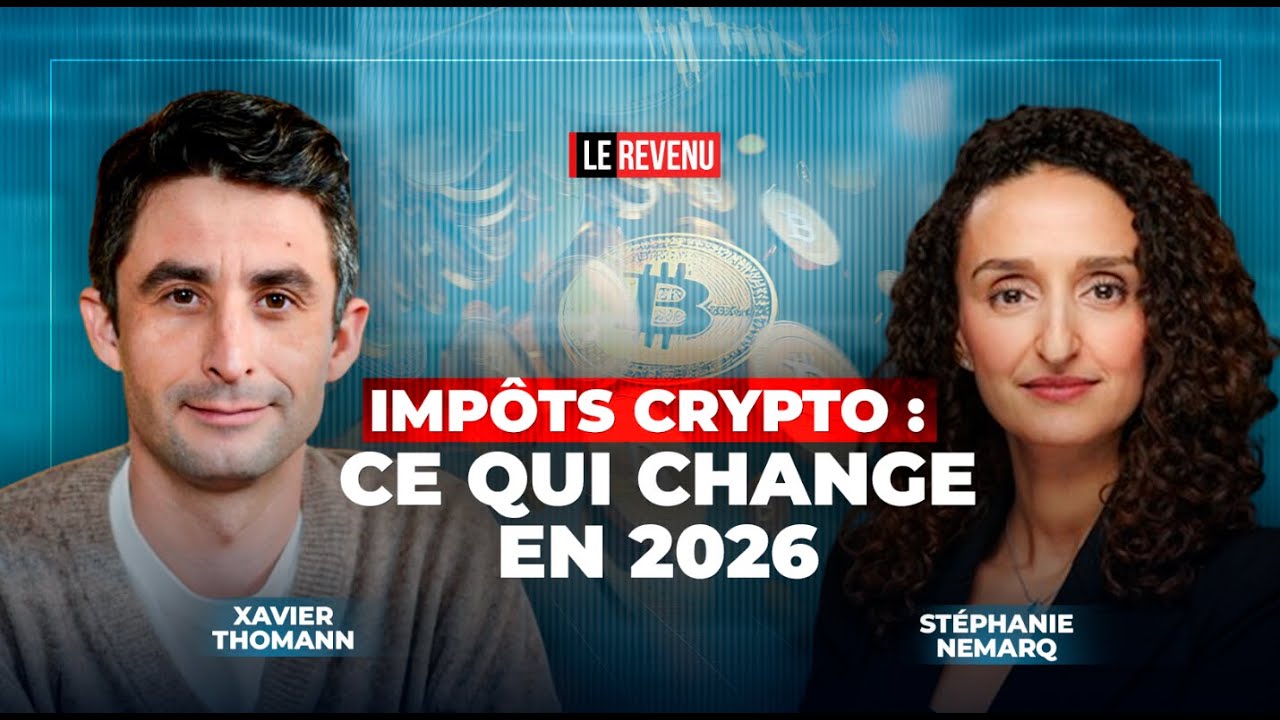
Impôts crypto : ce qui change en 2026

Photo of the author
Stéphanie Némarq-Attias
Founding partner at QOMIT

Interview sur les évolutions de la fiscalité des cryptomonnaies en France pour l'année 2026.

Cette vidéo présente les principaux changements réglementaires et leurs implications pour les détenteurs de crypto-actifs.

Transcript

[0:00] Already cryptoactive and digital asset, in fact, we can we can say to ourselves today that it is the same thing. The term active

[0:06] Digital is what we use in the General Tax Code, but it is the equivalent of cryptoactive. This

[0:12] asset class, it includes both cryptocurrencies. So that's the case with Bitcoin, ether and others

[0:17] cryptocurrencies. And it also groups together tokens, so we call them tokens. Which is very interesting,

[0:22] It is that there is a limited number of Bitcoins that can be created unlike fiat money

[0:29] as we know it. And so for many, it's also a way to fight inflation because of all

[0:35] In other words, we have a maximum of 21 million Bitcoins that can exist. You may simply want to diversify your

[0:42] wealth and therefore use cryptocurrency as a tool for diversification and of course

[0:48] performance as well. It is very very important to fully understand the tax rules that apply

[0:54] to the cryptoasset as soon as they are held, that is to say at the time of acquisition.

[0:59] And when I take them out, that is to say when I convert them into euros, how should I calculate my capital gain and

[1:06] How is this capital gain going to be taxed? When we talk about performance, we are mainly talking about net return. Net

[1:11] of taxes. The moment when we really pay tax is when we will recover in euros the cryptos that you

[1:18] hold. Once you have calculated the capital gain, it is taxed at 30%. So it's always flat

[1:24] tax. Uh, that's it with 17.2% social security contributions and 12.8% taxes

[1:29] on income. Hello Stephanie. Hello Xavier. So thank you for accepting our

[1:34] invitation. Uh I think for a start, could you

[1:40] present, recall a little bit the main stages of your career and what you are doing today and the subject

[1:46] What did you come to tell us about? So my name is Stéphanie Neymarq-Attias. I have been a tax lawyer for a while

[1:53] over 15 years now. I worked for a long time in a business firm

[1:59] Parisian called CMS Francis Lefèvre. And then today, I set up my firm called Qomit

[2:06] which is a law firm that is dedicated to providing tax support to entrepreneurs and investors,

[2:13] especially on crypto topics. Uh and today in fact, I just came to talk to you about

[2:19] cryptoassets, the taxation of cryptoassets, um, to give some general guidelines.

[2:26] um to understand this asset and today the fiscal regulation who

[2:32] applies to this new asset class. Alright. Maybe one last

[2:38] question about your background. What motivated you? What made you want to go to this

[2:46] area in particular? So I have always been very attracted to innovation in general and

[2:52] by changing tax rules related to innovation. And it is true that

[2:57] since 2019, we have had a whole legislative framework that is being built and that is linked precisely to

[3:04] these new investors and also these new activities that are linked to blockchain technology. Well, we have some

[3:10] Maybe we'll talk again later, um, but that's what motivated me to take an interest in this

[3:18] subject. OK Uh maybe maybe all of our uh readers and

[3:25] All of our all the people who are watching this interview are not necessarily hyper um aware of the

[3:33] Well let's just say what a cryptocurrency is, um, what is a cryptocurrency and what is a Bitcoin. So do we

[3:38] Maybe before going into more detail can we try to give a

[3:43] Understandable definition of everything dare I say? Yes. So, we're going to try to give a

[3:49] small definition. So, already cryptoactive and digital asset, in fact, we can say to ourselves today that

[3:55] it's the same thing. The term digital asset is what is used in the General Tax Code, but it is

[4:01] the equivalent of cryptoactive. Alright. This asset class, um, it includes both cryptocurrencies,

[4:08] So that's the case with Bitcoin, ether and other cryptocurrencies. And it also includes chips, um, so we

[4:14] Call them tokens. we are not going to talk about them today, but which are more related to the use that is made of these

[4:21] these tokens registered on the blockchain. As I told you, we're not going to talk about it today because today we

[4:27] is more interested in investing. In terms of investment, cryptocurrencies, well, the best known are

[4:32] Bitcoin. Uh, that's very interesting about this cryptocurrency, so it's existed since, um, um, no more than

[4:39] 10 years old actually, which is very interesting that um there is a number

[4:44] limited number of Bitcoins that can be created, um unlike fiat currency

[4:52] as we know it. And so for many, it's also a way to fight inflation because of all

[4:58] In other words, we have a maximum of 21 million Bitcoins that can exist. Alright. So it is a first advantage of

[5:05] this cryptocurrency. There are others. for example in your assets, you may simply want to diversify your

[5:11] wealth and therefore use cryptocurrency as a tool for diversification and of course

[5:17] Yield also, because as we have seen, there is a certain volatility, um, of these cryptocurrencies, sometimes downwards.

[5:24] but generally over a long period of time rather increasing. And so it's in

[5:30] a return objective that we can choose to diversify into this asset class. OK. Well exactly in what

[5:37] the universe of cryptoassets and perhaps that of Bitcoin, more specifically, in what it represents

[5:43] an opportunity for retail investors? So, as I said, um it's an opportunity

[5:50] today because um everyone is looking for a certain

[5:55] diversification, um, by agreeing to devote a part of your assets.

[6:01] So, obviously, there are some people um who have a strong appetite for

[6:07] risks that are able to devote a significant part of their wealth to cryptocurrencies. But in a way

[6:13] In general, we can see today that there is still 10% of the population in France who own

[6:19] cryptocurrencies. Yes, absolutely. That's a lot huh. Indeed, there was a study that came out, at last that comes out elsewhere

[6:25] every year. Uh, the last one was done by KPMG in partnership with ADAN, so who

[6:32] is the association for the development of digital assets and which is trying to precisely monitor the adoption of this

[6:38] asset class by the population and we realize that there is already 10% of the population who owns um at least one

[6:46] Cryptoasset account. As an aside, a lot of you are watching us.

[6:51] We are very happy about it, but not enough of you are subscribing to our channel. So please subscribe to our YouTube channel for

[6:58] more videos and also go to the physical world, go to the newsstands to discover our latest issue,

[7:05] Storm warning on your money. He is in all the kiosks, he will leave very quickly. Go and read it. Thank you so much

[7:11] and good luck. So we can see it clearly, diversification

[7:16] Is is a is an important issue and I told you also, there is the subject of inflation um that plays a role. There is

[7:24] other topics also, is that um, cryptocurrencies in fact, can be exchanged at any time, day or night.

[7:30] is harmful, internationally as well, unlike the trust model where

[7:36] we are a little bit framed precisely by the banking system. And since shares uh aren't traded all the time,

[7:42] So um absolutely. OK Uh OK. So um I imagine that

[7:48] Of course, taxation is an issue. Uh well, as soon as we make investments, taxation is an issue. And um but now in this case in

[7:56] What is a central issue, um, to secure this type of investment? So it is very very important to well

[8:04] understand the tax rules that apply to cryptoassets. But from theirs

[8:10] detention, that is to say at the time of acquisition, you need to know what will happen? Am I or

[8:15] not subject to reporting obligations? So when I have possession of it, do I have some

[8:22] Something to do with the tax authorities or absolutely not. And then then at

[8:27] When I exchange my cryptoassets for other cryptoassets, do I have to do anything? And when

[8:34] I bring them out, that is to say when I convert them into euros, how should I

[8:40] calculate my capital gain and how will this gain be taxed? So we can see, there is still at each stage

[8:46] Questions to ask yourself and today taxation is central, simply because when we talk about performance, we are talking about efficiency

[8:53] net of taxes. And so it is very important to know how will be taxed

[8:59] this performance. OK So maybe come back to one of the aspects uh one of the aspects that you just mentioned. Uh is it

[9:05] Does the simple possession of a cryptoasset mean tax obligations? Yes. And what are they? So

[9:12] yes, buying and holding cryptoassets primarily results in a tax liability

[9:19] Who is the one to declare your digital asset accounts when they are

[9:24] held on platforms abroad. That is to say, in the same way as when you have an account

[9:31] Banking abroad, you have this form called 3916 bis

[9:38] which details the name of each of your accounts opened abroad. So and I

[9:45] specify that it does not detail the amount of cryptoassets you hold but rather the name of the platform.

[9:53] Exactly. Existence. And this reporting requirement is very important because if you don't

[9:59] correctly, you risk penalties. I was going to ask you are these significant penalties or So are they penalties um around

[10:06] 1500€. OK. Uh but what's important is that it applies per account no

[10:11] declared and per year. So this means that if you have opened a certain number of accounts called wallets,

[10:19] Uh, crypto wallet, um, well, you're going to have to declare every time.

[10:24] each account otherwise you risk penalties. Alright. OK Well that's good to know. Uh so what if the value of

[10:32] My cryptos are increasing uh do I have to pay tax? So, that's what I was telling you earlier, it's

[10:38] That once we have passed this acquisition phase, well we have fluctuations uh in the value of your uh

[10:45] of these cryptocurrencies. And the interesting thing is that when you are an individual, that is to say you are not

[10:50] not a trading professional, well the only fact of holding cryptoassets

[10:56] Which will rise, fall et cetera does not create any obligations

[11:01] declarative. So you keep your cryptocurrencies, nothing happens in particular except this obligation to

[11:07] account statement. Oh yeah, okay. So finally, it's quite um simple, it's quite light as long as

[11:13] It's pure detention and you don't do much with it. Alright. Uh so all the inv

[11:21] Excuse me, are all crypto investors taxed the same way? So no, all investors

[11:27] crypto is not taxed the same way. Uh I said earlier, there is a real distinction to be made

[11:33] between non-professionals and professionals. OK The tax regime that applies in

[11:38] each of these situations is completely different. Uh, being specified that to identify what

[11:45] Who is a professional, you will have to analyze a lot of criteria um some criteria that are rather

[11:51] quantitative. For example, the number of trades you make, the amounts that are uh invested, what

[11:59] is the proportion between your traditional remuneration and the earnings that

[12:04] you are withdrawing cryptos. So these are quantitative criteria. There are also qualitative criteria that are linked to your profile. um for example your

[12:12] training et cetera. And once we have determined whether you are a professional or a non-professional, well then the

[12:18] tax regimes that apply are not the same. I told you, I think that today we are talking more specifically to no

[12:24] professionals and therefore we will stay precisely on this regime

[12:29] Uh, which is actually very interesting in France because when you do

[12:35] exchanges between crypto and crypto, i.e. you exchange for example a Bitcoin for ethers and well there

[12:43] It does not result in a tax return. Uh yeah, that's what I call crypto crypto exchange.

[12:50] In fact, there is a certain neutrality when you stay in the crypto universe at this level.

[12:55] Alright. So, maybe to explain again, so that things are clear. So at what point do we

[13:02] Is he finally paying taxes? So, when do we actually pay

[13:07] When are we going to recover in euros uh some cryptos that you

[13:15] hold. So for example, one day I want to buy a car

[13:20] Well now I'm going to get back some euros to make this acquisition and in

[13:26] In this case, I will have to calculate the capital gain, declare it on a specific form and

[13:33] then pay tax on this capital gain. OK? So, I'll say anyway, it's important, that if um the seller

[13:40] of this car says “Well listen, I agree to be paid in Bitcoin, no need to pay me in euros”.

[13:46] Yeah, we're allowed to do that in France. We have the right, it exists. Uh and by the way recently, there was the

[13:51] first real estate acquisition transaction in cryptoactive. It is it is

[13:57] very recent. Yes, it's interesting. Well actually, it's an event uh that also generates

[14:03] an increase in value and therefore tax. So you don't evade taxes, um, by buying goods directly from

[14:09] cryptoactive. Alright. So how are these earnings, um, taxed? So, these gains, so once you

[14:15] You did the calculation of surplus value, which I specify is more complex than a classical calculation of surplus value. OK?

[14:22] So it's not a calculation where you simply tell the difference between the selling price and the price

[14:27] of acquisition. It is a more complex calculation. I don't think we'll go into the details today

[14:32] That's it, but it often requires support to do it precisely. Well once we have

[14:38] Calculated this capital gain, it is taxed at 30%. So it's still flat tax.

[14:43] So there you go, still this famous flat tax with 17.2% social security contributions and 12.8% income taxes. Uh and

[14:51] So who will, who will apply and can I say, um, in some cases, for wealthy households that have a tax income.

[14:58] As an important reference, we can have additional contributions. So, we had the exceptional contribution

[15:05] on the income that is more so exceptional than that. Then we have a new contribution uh more recently, but um but anyway,

[15:13] What you should remember is still the 30% flat tax on gains um from cryptoassets.

[15:19] Alright. Uh so, a question maybe a bit naive or um in any case uh maybe a bit silly. Uh

[15:26] someone who would spend their time buying, selling Bitcoin several times a day. Was it at the time of

[15:34] Isn't having to declare all of this getting super complicated? Totally. OK. Totally. Me it happens to me

[15:40] very often to have customers who come to consult me and who have made hundreds of transactions in

[15:46] the year. So maybe because they didn't necessarily know that it would lead to obligations every time.

[15:51] declarative, either because well, they wanted to take advantage of

[15:57] take advantage of certain opportunities or to get out of certain positions. And here indeed, there is a job that is

[16:02] important enough to declare capital gains, do it properly. Uh that's actually why it's very

[16:09] It is important to keep records of each operation. Yes. And so let's imagine that here it is, I

[16:15] Personally I imagine that I would do 100 transactions in a year.

[16:21] When do I declare them? How do I organize myself? Uh

[16:27] Here are your tips so as not to get lost and not to do anything stupid in the end. So what

[16:34] is quite practical, it is that the declaration is made at the same time as the declaration of your others

[16:39] earnings. So in April, May, every year, you file your declaration and that's when the capital gains are calculated. So the moment,

[16:47] That's the one. Uh the difference, I would say, is that we're not going to be helped

[16:52] by banks, for example, who send us IFUs where we only have to postpone an amount. There is there really is a

[16:58] do-it-yourself work. In any case, today that is the case. And as I was telling you, this calculation is enough

[17:03] complex. So what is very important is a recover all the

[17:09] supporting documents at the time of each operation. It is always much more difficult to find supporting documents

[17:15] transactions from the past year rather than accumulating them over time and taking contact with a lawyer

[17:22] tax specialist if we need it, if the volume of transactions requires it um

[17:27] To um here help with this calculation

[17:32] Strictly speaking, it is true that there is a very significant increase in fiscal controls on these subjects.

[17:39] Alright. So um maybe it's something um finally someone who would like to invest uh so our readers

[17:45] want to invest in Bitcoin, um, you have to, um, keep in mind that if, um, they make a lot

[17:51] transactions, they may still be forced to call on you or

[17:57] one of your colleagues and that this is perhaps something to take into account in their investment strategy. So, I would say that

[18:02] It really depends on the profiles, huh. There are some of the individuals who

[18:08] keep extremely accurate reporting of their operations and who like to dive into the calculations. It is

[18:16] doable. Now, it's true that you have to devote a little bit of time to it. The formula is not necessarily

[18:22] Very um clear, I would say, but there is no obligation to use a

[18:28] tax lawyer. It's really a help to secure yourself and sometimes also to optimize certain things because

[18:35] that there are some levers to know. Well, what do we know when we

[18:40] is in the business and that we do that on a daily basis. There you go. So I would say you anyway

[18:47] Do you have the option of using a professional if you do a lot of operations and if you need

[18:52] help to keep you safe. Yes, I think if I were in that situation, I know what I would do

[18:59] if I did several hundred transactions every year. If we come back a little bit more to the to life

[19:04] daily, if I pay if I buy a property with a card of

[19:11] payment in crypto, so from a fiscal point of view, what is going on? So it actually happens

[19:17] Today, there are payment cards backed by cryptoactive accounts. So that means that

[19:23] In concrete terms, we use these cryptos to acquire a property. And that's what I told you earlier um when we

[19:28] buys a good and this is also the case for a service. So for example, um, you're going to, um, do a

[19:35] massage and you want to pay in cryptoassets, well that's the equivalent of a conversion into euros

[19:42] and an acquisition. So in fact, you do not escape tax when you acquire a property or a

[19:48] service, whether via a payment card or otherwise. You have to be well

[19:54] awareness that this involves declarative obligations. Alright. But that no, sorry, I

[19:59] No, no, I was going to tell you with one exception, which is very important, which is that if all of

[20:07] your annual transfers do not exceed €305 well in this case, there is no

[20:13] taxable capital gain. OK Uh so, but if I if I combine

[20:19] A bit like the previous question with this one, um if I spend my day buying everything in crypto, I don't know if

[20:25] It is possible in fact, but let's admit, take this hypothesis, um now it's the same, it becomes very very

[20:32] complicated from a fiscal point of view, isn't it? It is true. So, complicated, I would say uh

[20:40] It's the statement that's complicated um in fact. It's just very easy to take out your card

[20:46] of payment and to pay with a crypto underlying. There is no complexity but on the other hand it requires

[20:53] regular follow-up. So, we can get back some sort of statements uh

[20:58] some platforms that precisely offer these payment cards and that make it possible to greatly simplify

[21:04] Uh the information retrieval. OK Well, I think I got it all right. It is already clearer

[21:11] for me. I hope it's clearer for everyone. Uh the next question,

[21:18] so how do we do it? What are the the ways to optimize all this a little bit? What is what is

[21:23] Can you recommend? So, there are a few ways that exist. Well, afterwards, it is each time on a case-by-case basis that we analyze

[21:30] things, but what I can tell you in any case today is that the means that exist and that are

[21:35] interesting levers, they are simply in the law. So, the first lever is

[21:42] that today, you have the option of opting for the progressive income tax schedule instead of the

[21:48] flat tax. So that's an interesting lever because depending on all of your income within the

[21:54] Home, it can help you lower your capital gains tax. So instead of being at 30, we can be at minus. So

[22:00] That's an interesting first lever. Then, there is a second lever that is interesting, it is the use of

[22:07] loss of value. So if you have several cryptoassets, so ethers,

[22:13] Bitcoin and then at some point, you say to yourself well I want to get out of certain positions, some are going to be

[22:20] um in added value, others in depreciation. Well already, you can deduct capital losses

[22:27] Of capital gains in the same year. it can be a can be identified on a case-by-case basis

[22:33] Case and then in fact there is a thought to have at the end of the year before the 31st on whether I have no interest in

[22:40] get out of certain positions? So that's it, it's an analysis that needs to be carried out um and can I say how

[22:48] General um that finally there is a lot of information related to your household

[22:54] fiscal measures that will have to be taken into account in order to possibly optimize

[23:00] Secure huh, I mean your your tax on this type of gain.

[23:05] Alright. So you talked about it uh a little bit earlier in

[23:11] the interview. It seems to me that you said that there was more and more control by the tax authorities. So

[23:18] So how has that evolved over the last few years? The the look, the

[23:24] the control of the tax authorities on the on cryptos. So, I would say that the view of the tax authorities a few years ago, good

[23:32] It was a crypto it was a little bit of a curious beast. So now, as I said, there's

[23:38] has more and more people who have crypto accounts. So it is being democratized. So we have exchanges of

[23:44] more and more fluid with tax services. Alright. Obviously, it depends on the services, it depends on the of the auditors, but

[23:51] In any case, what is clear is that today um the tax authorities have

[23:56] much more information than before to cross-reference data.

[24:02] So what does that mean? That means that before, well, it was essentially a declarative system,

[24:08] that is to say, taxpayers declared a certain amount of information and the tax authorities could

[24:13] check if he was interested in this tax household. Today, in fact, there are a lot

[24:20] information that is sent directly to the tax services. So either by the banks or by the

[24:26] platforms, um or simply through what we call data mining, that is to say the search for data and

[24:33] The analysis by AIs um that will precisely cause um more

[24:38] Check and we can see that um already today, it will increase.

[24:43] OK Uh, a little earlier, you talked about the risks involved if we didn't declare

[24:48] not the existence of of his account. So what are the risks involved if we

[24:55] Are we making a bad statement concerning these cryptos? So, if we

[25:00] makes a bad declaration, that is to say, if you either do not declare capital gains, or you declare them incorrectly,

[25:07] In fact what we risk are tax reminders. So that means a recalculation of the tax that should have been

[25:13] paid. Uh and to that, we add late payment interest so who is somewhere the

[25:20] what was considered to be the damage of the treasure. That is to say, he received his money late. And

[25:26] Well, at the end of the day, these late payment interests are not very large amounts in general because it is

[25:32] calculated at a rate of 2.4% per year. The problem is the increases.

[25:38] OK? That is to say, um, in some cases, um, we can have a 10% markup

[25:44] taxes, 40% increase or 80% increase. And now we really reach

[25:50] very significant amounts that sometimes can go beyond the earnings themselves. Uh and that 10%, 40%, or 80%

[25:58] depend on the severity of the fault according to the tax services. does

[26:04] Are we on a simple oversight? Are we on a voluntary basis? The right to be forgotten, to

[26:10] the error. The right to make mistakes or there you go, that's it. So it's a question of whether there was a

[26:16] Fraudulent scheme that was set up just to evade taxes or if

[26:21] it is simply an oversight that needs to be fixed. And here, of course, the penalties are lower. Things need to be corrected

[26:28] um quickly and cooperate to avoid

[26:33] and simply show good faith. Alright. So all of these explanations are very clear. Me, I have I learned

[26:39] lots of stuff. Uh, despite everything, there may be people who are still reluctant to invest in

[26:45] cryptos. What could you because we also mentioned a little bit about all the obligations

[26:51] engender? What could you say to reassure people who are still saying, “Yeah, well, that's it, that sounds nice but he's fine.

[26:58] I have to call a lawyer, I'm going to have to be super careful. So how can we reassure them? So already to reassure them,

[27:05] What I can what I can say is that today the tax system is still quite clear.

[27:11] That is to say, if we were talking to each other before 2019, I would have told you we are still a little bit in a zone

[27:17] grey. Today, the regime is quite clear. Alright. So that's a good thing.

[27:22] Uh then, I would say that as soon as we are interested in the subject, well in fact it's the same thing that must

[27:28] be done every year. So if you master your declarations in a given year, well then we start again.

[27:36] the following year. For me, sometimes I have customers who come to me and say “Well, I want to do

[27:41] Things very cleanly, to understand what I need to do this year and then I'm in fashion

[27:48] of employment and the following years, I would be able to do it alone and I give them all the advice so that they

[27:54] are able to be in autonomy precisely.” So that, I would say for me it is reassuring from the point of view of

[28:01] Taxpayer is that once you have learned how to do it, well you can manage on your own. Yes, I see. Alright. And um maybe

[28:08] to finish off a slightly more general question. We came back, we have

[28:13] tendency to encourage people to be cautious about cryptoassets, especially if, um, they don't understand

[28:20] Very good what it is about. And then we also tend to tell them not to venture outside of Bitcoin.

[28:28] or ether um when there are thousands of cryptocurrencies out there.

[28:34] You What is your point of view? Do you really have to stay in in Bitcoin and ethers or that

[28:40] Is it worth taking a quick trip elsewhere? So, I think that at the start, we have

[28:46] Interest in staying on safe values, but I would say that we can add to the

[28:52] Bitcoin and ether other cryptocurrencies that are fairly well known. Then maybe I would like to make a quick point about this

[28:57] They call them stable coins. Oh yeah, very interesting. Uh, it's interesting because right now, we're saying to ourselves that we want to

[29:02] stay in a secure universe. The stable coin is in fact a cryptocurrency

[29:08] which is backed by an asset such as gold or the dollar. And

[29:14] So there is a certain bah the volatility is less obviously what if

[29:19] We want to stay in a more secure universe, it can also be an alternative by saying good well there you go

[29:26] Some times I exchange Bitcoin for stable coin because I want to stay on a stock that

[29:33] Uh, so does the value of gold. So yeah, but I think I finally see it at

[29:38] On a daily basis, it is by becoming interested in the subject that we start trying

[29:43] Things about small amounts that are a bit riskier and then we realize that well in fact it's a

[29:50] position that had a certain interest in terms of return. So yeah, I think that the advantage we have in France of

[29:57] This neutrality on crypto to crypto exchanges is precisely to be able to

[30:02] try to move on to other positions without having to make specific statements. So my

[30:10] The advice is to go step by step. OK Uh and then um and then then to see if it's an asset that's right

[30:17] And um, in which we want to get more involved, while obviously remaining moderate. Uh, we often say

[30:24] You only invest what you are prepared to lose. We say that in every field. Well, it's the same here.

[30:30] If I'm not talking nonsense, now there are Bitcoin ETFs. That can be interesting for someone who is

[30:36] still a bit reluctant or who Yes. who does not necessarily master the technical side of things. Absolutely. Absolutely. It is it is

[30:42] another possibility. Well, it's the same principle as an ETF as we know them um who follows the value and who

[30:49] allows for some diversification as well. Alright. But to summarize, if I understand correctly, you still have to um

[30:55] Um have a minimum uh of interest in uh for the for the Bitcoin, for for

[31:00] cryptos in general. I think that anyway, um, you should never go anywhere with your eyes.

[31:06] closed. So, there are more and more wealth management advisers, huh, who offer um here's a

[31:13] Uh uh partial investment uh in cryptocurrencies. So it can also be

[31:18] A solution to say well I go through a third party um to make this investment, a third party who may be in control a little

[31:25] plus the subject. I think that anyway, when you invest, you have to be informed. I think that

[31:32] financial information is essential. Yes, it is something that is put a lot of emphasis on regardless of the product.

[31:37] Exactly. and and I actually find that the income um is completely in this in this approach of informing about

[31:45] any type of investment and then well then well it leaves the choice and the possibility to dig when you want to

[31:51] to find out more about one of the asset types. So I just thought of a question

[31:57] Probably a little bit stupid, but the taxation is the same regardless of crypto.

[32:04] Exactly. Very yes, absolutely. Whether you are selling Bitcoin, Ethers,

[32:09] In any case, we will be taxed on a 30% flat tax.

[32:15] Alright. Well well, thank you so much Stéphanie. With pleasure. Uh well, I hope we get the

[32:22] The opportunity to talk about all this again and then maybe to discuss other aspects, especially entrepreneurs um

[32:29] because you also work with businesses. Absolutely, absolutely. Uh so I hope we get a chance to talk

[32:34] of that and then maybe other digital assets. With pleasure. Thanks. If you liked this video,

[32:41] Don't forget to like it and subscribe to our channel.

Vous souhaitez optimiser votre fiscalité et sécuriser vos investissements ?